Most AI engineering job descriptions ask for years of software engineering. Very few ask for years of AI.
We checked. On 22 October 2026 we pulled every open role from the public job boards of 43 companies. 24 of them had roles that fit: AI labs like OpenAI and Anthropic, AI startups like Sierra, Harvey and Sarvam, and software companies like Stripe, GitLab, Databricks and Asana. We kept the roles where the job is building product features with models someone else trained. We left out model training, GPU infrastructure, research, managers and forward deployed roles. When the same role was posted in five cities, we counted it once.
That left 57 job posts. We counted with a keyword search, then read every matching line to check it meant what we thought.
What the sample is, and isn't
Be careful with this sample before you lean on it. It leans senior and it leans American and European. Five of the 57 roles are in India (Bengaluru and Gurugram). None are in Pune. Indian service companies are not in it, because their postings don't sit on the public boards we could read. So treat it as a picture of what AI-first companies ask for, not of every AI job in India.
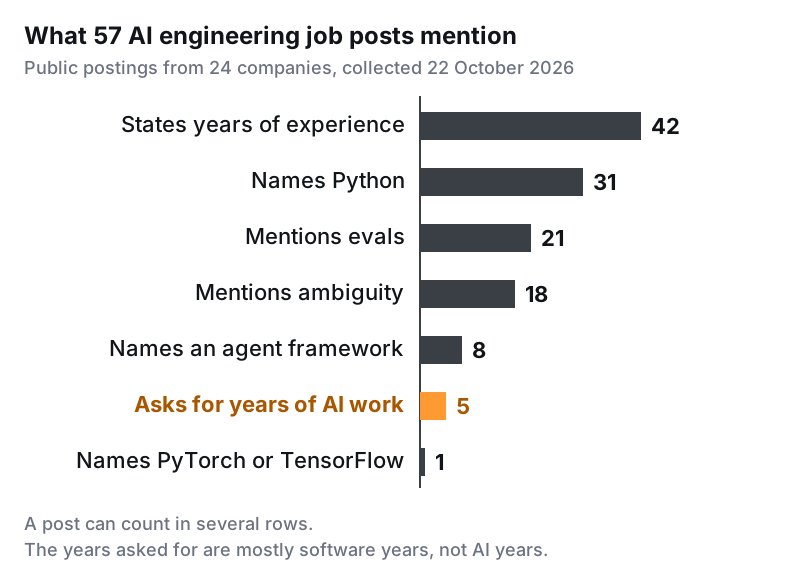
The years are software years
42 of the 57 posts state years of experience. Read the line closely and it is almost always software years: "4+ years of experience as an engineer shipping production systems" (Stripe), "3+ years of industry experience in software engineering" (Decagon).
Only 5 posts put a number on AI experience. The numbers were 1, 2, 3, 5 and 5 years. A typical one is Figma's: five years of software engineering, "with 1 or more years of developing generative AI products".
This matters, because "3+ years of AI experience" scares people away who shouldn't be scared. The field in its current form is barely that old. Most people who got these jobs had backend experience and picked up AI on the job. The posts in this sample mostly agree: they want a good engineer who has also shipped something with a model.
If you have shipped one AI feature end to end, apply.
The same title, two different jobs
"AI engineer" in these posts means one of two jobs. Read which one before you apply.
The first builds AI features inside the company's own product. Figma, Asana, Intercom, GitLab and Linear post roles like this. Your users are the product's users, and you sit in a product team.
The second builds with the company's customers. At the model labs, "Applied AI Engineer" usually means this. OpenAI's enterprise role says success is measured by "production systems, sustained adoption, and meaningful customer impact", not by demos. Anthropic's startups role asks for experience in a customer-facing or pre-sales technical role, and includes pair programming with customer teams and travel to customer sites. That is close to a forward deployed engineer.
Same title. Very different weeks.
Almost nobody asks you to train models
Only one post named PyTorch, TensorFlow or JAX. Two mentioned a PhD, both as one option among degrees. Fine-tuning came up in 9, usually as one tool among several, not the core of the job.
This fits what Andrej Karpathy said back in 2023, quoted in The Rise of the AI Engineer: one can do well in this role "without ever training anything". Three years later, the job posts agree.
Framework lists were rarer than we thought
We expected long lists of framework names. They were rare. Only 8 of 57 named LangChain, LangGraph, LlamaIndex or similar. When they did, it was usually the team's own stack: GitLab builds its agent features on LangGraph, so it says so.
Languages were named more often. Python appeared in 31 posts. TypeScript, JavaScript, Node or React appeared in 21. Many roles are full stack.
So don't spend a month collecting framework names for your CV. Nobody in this sample asked for ten of them.
What they actually ask for
Three things came up again and again, in different words.
Evals. 21 posts mention evals or an evaluation harness. Baseten wants you to "define and instrument evals so you know whether a change actually improved output quality". Chip Huyen makes the same point in AI Engineering: evaluation matters even more with foundation models, because open-ended answers have no single right output to compare against.
Failure modes. Sarvam's Agent Engineer post, from Bengaluru, says the hard part "is not the first version". It asks you to engineer "for the failure modes instead of the happy path". This is the same thing I say about the job: an AI engineer spends the day figuring out where the feature fails.
Ambiguity and people. 18 posts use the word "ambiguous" or "ambiguity". Stripe's AI Engineer is "embedded directly" with a team of solutions architects and has to turn "ambiguous business needs" into deliverables. The line between tech and domain requirements is getting blurry, and the posts show it.
Look at those three together. None of them is a tool. All of them are about knowing when your system is wrong.
What I would look for if I were hiring
One thing you built. What broke. How you found out.
Not a list of tools. Here is mine. We built a chatbot that answered employees' policy questions. The client kept rejecting it, so we went through the answers one by one and found it was quoting old versions of policies, because retrieval ranked by similarity and ignored dates. Three sentences, and they show evals, failure modes and production. That is most of what these 57 posts ask for.
If you want to see how that story looks on a profile, read profiles that get replies. If you want to know why every other job post now mentions AI at all, read why every JD mentions AI.
One thing to do this week
Pick three AI engineering posts you would like to apply for. Highlight every line that asks for years. Next to each, write "software" or "AI".
Then write your one story in three sentences: what you built, what broke, how you found out. If you don't have that story yet, that is the thing to build next, not another certificate.